ad

‏إظهار الرسائل ذات التسميات ENVIRONMENT. إظهار كافة الرسائل


In just over two weeks, more than 100 world leaders will gather in the Scottish industrial city of Glasgow for United Nations climate change negotiations known as COP26. Their task, no less, is to decide the fate of our planet.

This characterisation may sound dramatic. After all, UN climate talks are held every year, and they’re usually pretty staid affairs. But next month’s COP26 summit is, without doubt, vitally important.

In the landmark 2015 Paris Agreement, each nation pledged to ramp up their emissions reduction pledges every five years. We’ve reached that deadline – in fact, a one-year delay due to the COVID pandemic means six years have passed.

This five-yearly requirement set a framework for countries to reach net-zero emissions across the global economy by mid-century. The Glasgow summit is the first real stress test of whether the world can meet that goal.

COP26 is a major test of the Paris Agreement framework. Photo: Mika Baumeister.

Global mega-trend toward a clean economy

The Paris Agreement was the world’s first truly global treaty to cut greenhouse gas emissions. It set a shared goal for countries to limit global warming to 1.5? above the long-term average.

The agreement has been signed and ratified by 191 of the world’s 195 countries, giving it near-universal legitimacy.

But the actual emissions-reduction commitments countries brought to Paris, known as “Nationally Determined Contributions”, left the world heading toward 3? of warming this century. This outcome would be cataclysmic for ecosystems and human societies.

That’s why, every five years, countries must bring progressively stronger pledges to reduce emissions.

The years since the Paris summit have seen a dramatic shift towards climate action. Today, countries representing more than two-thirds of the global economy have set a firm date for achieving net-zero emissions.

More importantly many jurisdictions – including the United States, United Kingdom, European Union, Japan and Canada – have substantially strengthened their 2030 targets. This constitutes a powerful market signal, driving a global reallocation of private and public investment from fossil fuels toward clean energy solutions.

What’s at stake in Glasgow?

While the world is moving fast, there remains a crucial gap between current pledges and the goals of the Paris Agreement. Glasgow is seen as the last chance to close that gap and keep the 1.5? goal within reach.

Without stronger national commitments, we risk crossing irreversible “tipping points” in the Earth’s climate system, locking in uncontrollable global warming.

The Australian government has inched toward announcing net-zero emissions by 2050. But such a commitment will not be seen as particularly helpful in Glasgow.

In reality, such announcements are merely the summit’s entry ticket. Discussions have moved on, to ensuring much deeper cuts this decade.

Barring Australia, almost all advanced economies have set new 2030 targets to slash carbon pollution. By 2030 the UK, the summit’s host nation, plans to cut emissions by 68% below 1990 levels. Meanwhile, the US will cut emissions by 50-52% below 2005 levels.

The G7 countries have announced they will collectively halve emissions by 2030. There are clear expectations Australia will follow suit.

At present, Australia plans to take to Glasgow the same 2030 target it took to Paris six years ago – a 26-28% cut by 2030, from 2005 levels. Prime Minister Scott Morrison has hinted he will take an upgraded 2030 projection (rather than target), but this ruse won’t pass muster.

The Paris Agreement is about targets, and countries are required to set new targets representing “highest possible ambition”. If projections suggest we will outperform our target, a new 2030 target is clearly needed.

Global diplomatic pressure is driving a sea change in Australia’s climate politics. Just this month, the Business Council of Australia backed cuts to emissions by 46-50% by 2030. The Murdoch press has thrown its weight behind net-zero emissions. Even many conservative Nationals MPs appear to have dropped opposition to a net-zero target.

There is also dawning recognition within the Morrison government that the global energy transition is underway, and it will significantly boost Australia’s economy.

The Albany Wind Farm is one of the most spectacular and largest wind farms in Australia. Photo: bmphotographer.

Thriving in a net-zero world

Australia’s economy is shaped by trends in the global marketplace. The international car market is switching rapidly to electric vehicles. And around the world, wind and solar energy are now cheaper than coal and gas.

Our export markets are changing too. As growing economies in Asia meet their climate targets, they will no longer want to buy coal and gas. Instead they’ll want renewable energy, delivered directly via undersea cable or stored as renewable hydrogen.

Such nations will still want Australian iron ore. But increasingly, they will want “green steel” made using hydrogen instead of coking coal.

Global demand for batteries, electric vehicles and renewable energy technologies will drive Australian exports of critical minerals – including lithium, cobalt and rare earths. Globally, these minerals will be worth A$17.6 trillion over the next two decades.

With the right policy settings, Australia could grow a clean export mix worth A$333 billion annually, almost triple the value of existing fossil fuel exports.

Getting to net-zero could also create 672,000 jobs, and generate A$2.1 trillion in economic activity by mid-century.

Commitments in Glasgow will spark a global race toward net-zero. But it is not a race we should be scared of. If we embrace the transition, Australia will prosper. It’s time to get started – we have a world to win.

This article is republished from The Conversation under a Creative Commons license. Author: Wesley Morgan, Researcher, Climate Council, and Research Fellow, Griffith Asia Institute, Griffith University.


Australia is experiencing widespread, rapid climate change not seen for thousands of years and may warm by 4? or more this century, according to a highly anticipated report by the Intergovernmental Panel on Climate Change (IPCC).

The assessment, released on Monday, also warns of unprecedented increases in climate extremes such as bushfires, floods and drought. But it says deep, rapid emissions cuts could spare Australia, and the world, from the most severe warming and associated harms.

The report is the sixth produced by the IPCC since it was founded in 1988 and provides more regional information than any previous version. This gives us a clearer picture of how climate change will play out in Australia specifically.

It confirms the effects of human-caused climate change have well and truly arrived in Australia. This includes in the region of the East Australia Current, where the ocean is warming at a rate more than four times the global average.

We are climate scientists with expertise across historical climate change, climate projections, climate impacts and the carbon budget. We have been part of the international effort to produce the IPCC report over the past three years.

The report finds even under a moderate emissions scenario, the global effects of climate change will worsen significantly over the coming years and decades. Every fraction of a degree of global warming increases the likelihood and severity of many extremes. That means every effort to reduce greenhouse gas emissions matters.

Related Post: Not Declaring the Great Barrier Reef as ‘In Danger’ Only Postpones the Inevitable

As the climate becomes more extreme, bushfire risk increases. Photo: Matt Palmer.

Australia is, without question, warming

Australia has warmed by about 1.4? since 1910. The IPCC assessment concludes the extent of warming in both Australia and globally are impossible to explain without accounting for the extra greenhouse gases in the atmosphere from human activities.

The report introduces the concept of Climate Impact-Drivers (CIDs): 30 climate averages, extremes and events that create climate impacts. These include heat, cold, drought and flood.

The report confirms global warming is driving a significant increase in the intensity and frequency of extremely hot temperatures in Australia, as well as a decrease in almost all cold extremes. The IPCC noted with high confidence that recent extreme heat events in Australia were made more likely or more severe due to human influence.

These events include:

  • the Australian summer of 2012–13, also known as the Angry Summer, when more than 70% of Australia experienced extreme temperatures
  • the Brisbane heatwave in 2014
  • extreme heat preceding the 2018 Queensland fires
  • the heat leading into the Black Summer bushfires of 2019-20.

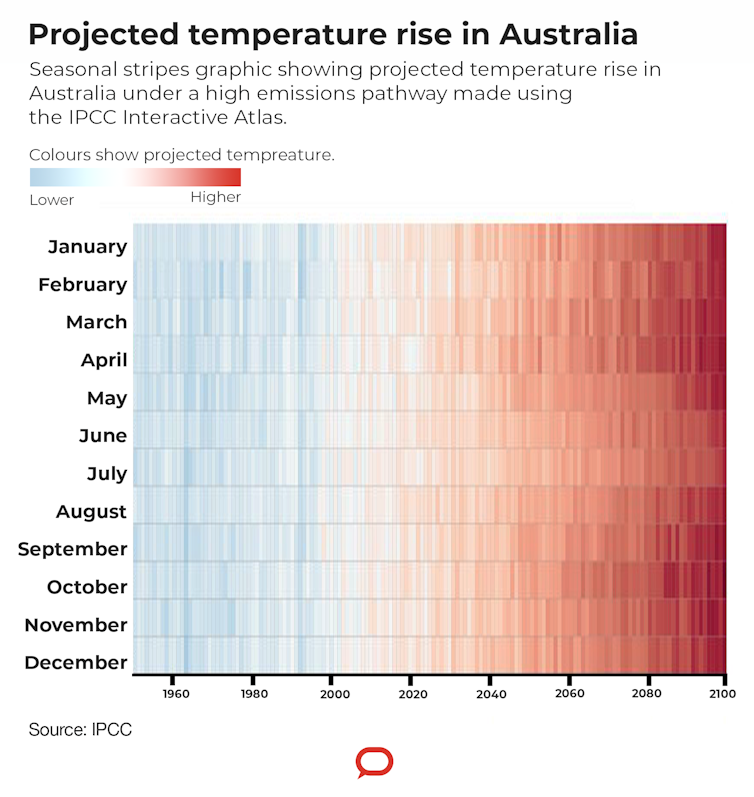
The IPCC report notes very high confidence in further warming and heat extremes through the 21st century – the extent of which depends on global efforts to reduce greenhouse gas emissions.

If global average warming is limited to 1.5? this century, Australia would warm to between 1.4? to 1.8?. If global average warming reaches 4? this century, Australia would warm to between 3.9? and 4.8? .

The IPCC says as the planet warms, future heatwaves in Australia – and globally – will be hotter and last longer. Conversely, cold extremes will be both less intense and frequent.

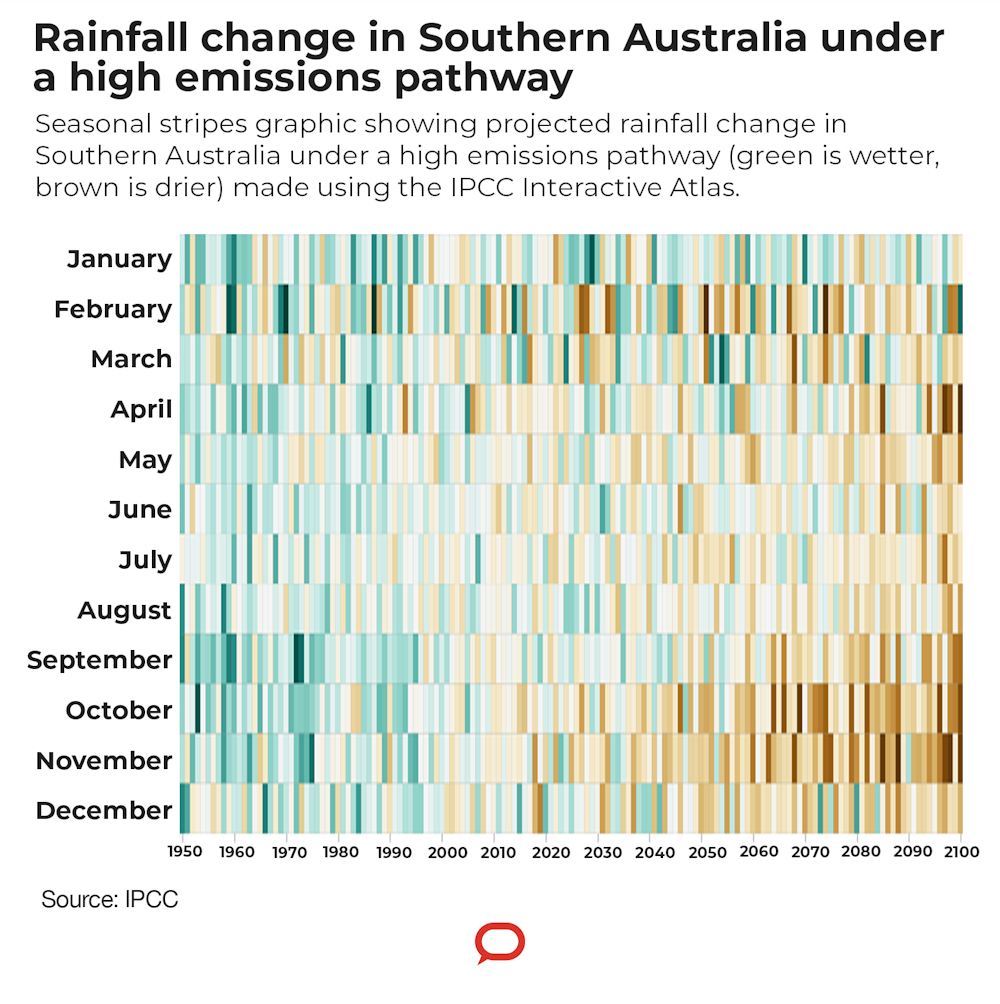
Hotter temperatures, combined with reduced rainfall, will make parts of Australia more arid. A drying climate can lead to reduced river flows, drier soils, mass tree deaths, crop damage, bushfires and drought.

The southwest of Western Australia remains a globally notable hotspot for drying attributable to human influence. The IPCC says this drying is projected to continue as emissions rise and the climate warms. In southern and eastern Australia, drying in winter and spring is also likely to continue. This phenomenon is depicted in the graphic below.

Climate extremes on the rise

Heat and drying are not the only climate extremes set to hit Australia in the coming decades. The report also notes:

  • observed and projected increases in Australia’s dangerous fire weather
  • a projected increase in heavy and extreme rainfall in most places in Australia, particularly in the north
  • a projected increase in river flood risk almost everywhere in Australia.

Under a warmer climate, extreme rainfall in a single hour or day can become more intense or more frequent, even in areas where the average rainfall declines.

For the first time, the IPCC report provides regional projections of coastal hazards due to sea level rise, changing coastal storms and coastal erosion – changes highly relevant to beach-loving Australia.

This century, for example, sandy shorelines in places such as eastern Australia are projected to retreat by more than 100 metres, under moderate or high emissions pathways.

Some sandy shorelines may retreat by more than 100 metres. Photo: Unsplash.

Hotter, more acidic oceans

The IPCC report says globally, climate change means oceans are becoming more acidic and losing oxygen. Ocean currents are becoming more variable and salinity patterns – the parts of the ocean that are saltiest and less salty – are changing.

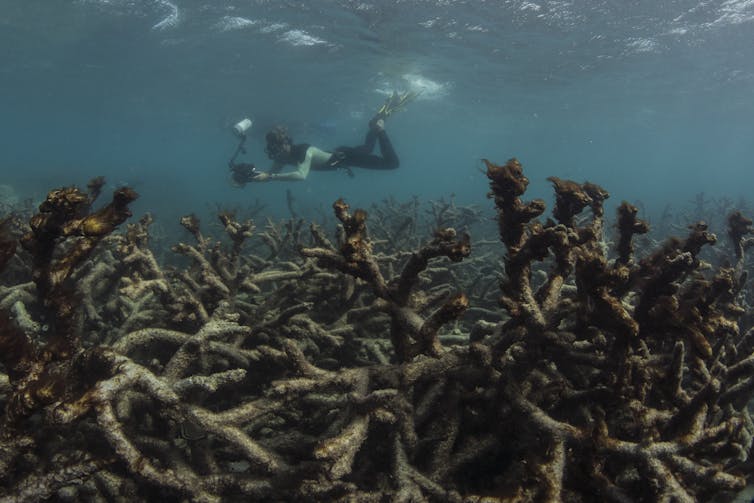
It also means sea levels are rising and the oceans are becoming warmer. This is leading to an increase in marine heatwaves such as those which have contributed to mass coral bleaching on the Great Barrier Reef in recent decades.

Notably, the region of the East Australia Current which runs south along the continent’s east coast is warming at a rate more than four times the global average.

The phenomenon is playing out in all regions with so-called “western boundary currents” – fast, narrow ocean currents found in all major ocean gyres. This pronounced warming is affecting marine ecosystems and aquaculture and is projected to continue.

bleached coral with diver
The region of the East Australia Current, which includes the Great Barrier Reef, is warming at a rate more than four times the global average. XL Catlin Seaview Survey

Where to from here?

Like all regions of the world, Australia is already feeling the effects of a changing climate.

The IPCC confirms there is no going back from some changes in the climate system. However, the consequences can be slowed, and some effects stopped, through strong, rapid and sustained reductions in global greenhouse gas emissions.

And now is the time to start adapting to climate change at a large scale, through serious planning and on-ground action.

To find out more about how climate change will affect Australia, the latest IPCC report includes an Interactive Atlas. Use it to explore past trends and future projections for different emissions scenarios, and for the world at different levels of global warming.

This article is republished from The Conversation under a Creative Commons license. Authors: Michael Grose, Climate projections scientist, CSIROJoelle Gergis, Senior Lecturer in Climate Science, Australian National UniversityPep Canadell, Chief research scientist, Climate Science Centre, CSIRO Oceans and Atmosphere; and Executive Director, Global Carbon Project, CSIRO, and Roshanka Ranasinghe, Professor of Climate Change impacts and Coastal Risk.


In July, the European Union released what it calls its Roadmap to a sustainable future, a monumental progress especially in the wake of the G7 Summit which failed to make substantial climate progress. While the move was huge, it did not come totally unexpected. From EU elections to the Green Deal presented in December 2019, the European Union has made it clear that they hold climate sustainability as a priority.

The roadmap aims to achieve a Net Zero Europe by the year 2050. This will be achieved through wide sweeping policy and environmental reforms in transportation, trade and even shipping and aviation which before now have not been covered in most carbon reduction efforts. Historically such decisions by the global West often have second and third-degree effects on the developing nations. Therefore, upon hearing this announcement, I could not but think about what the effects would be on countries like my home country of Nigeria.

One of the highpoints of the roadmap is the plan to phase out gas-powered cars. According to the European Commission, the new policy will require the auto industry to slash the average emissions of new cars by 55% by 2030. A further reduction to 100% by 2035 would effectively mean that all new cars registered from that year onward must be zero-emission vehicles. It’s all good until you realise that 80% of cars imported into Africa are fossil-fuel based second hand cars.

In all likelihood, this policy will have inadvertent effects on the Africa continent by making it the dumping ground of used cars for the rest of the world. From fashion waste to the more environmentally harmful electronic waste, the roadmap for Western Nations has always been to shirk their responsibilities and simply dump them on other nations. I have no reason to believe that this issue of fossil fuel-based cars will be any different.

Another highpoint of the policy is the Carbon Border Adjustment Mechanism (CBAM), a system intended to combat “carbon leakage”. To assist the prevention of climate change, countries across the globe have various greenhouse gas emission rules, with some being stricter than others. For instance, in the past few years, Europe has developed an increasingly stringent carbon regime. Many companies are required to pay taxes on each tonne of carbon they use. This in turn has created Carbon Leakage.

Carbon leakage occurs when a firm decides to shift manufacturing from a country with strict policies to one with laxer policies, resulting in an increase in greenhouse gas emissions. Carbon leakage refers to the additional emissions caused by the transfer. For example, whereas carbon emissions in the United States and Europe have been declining for years, emissions in developing countries such as China and India have been significantly increasing. While domestic growth accounts for the majority of the increase in greenhouse gas emissions in developing nations, it’s no secret that companies based in wealthier countries set up plants in poorer countries to save money and circumvent restrictions, contributing to global pollution.

I do not for one second think that the European did not see this coming. It is entirely possible that when the EU created these policies, what they had in mind was for these big companies to move their operations elsewhere; simply put, “go pollute somewhere else”. In their defence, the EU is now taking action towards curbing carbon leakages by creating the CBAM. CBAM, simply described, is a policy of imposing a carbon tax on goods imported into the EU by companies who manufactured them in countries with fewer carbon restrictions. 

The workings of the CBAM seems good in theory, but in practice, things aren’t nearly as great. According  to a report by the United Nations Conference on Trade and Development, the mechanism’s value in combating climate change is limited, as it would only save 0.1% of world CO2 emissions. If the proposal is executed with a tax of $44 per tonne of CO2 emissions, exports by poor nations will be reduced by 1.4%, and by 2.4% if the price is $88 per tonne. According to the analysis, at a $44 per tonne price, developed nations’ income would increase by $1.5 billion, while developing countries’ income would decrease by $5.9 billion.

Related Post: The Commodification of Water is the Answer to Scarcity Experts Argue, But What Are the Implications for Africa?

According to UNCTAD, “While the system aims to prevent manufacturing and CO2 emissions from leaking to EU trading partners with less strict emissions objectives, it is yet unclear how it can help decarbonization in developing countries.” So, in reality, what it does is to work more hardship on these countries and economies which are already disadvantaged in global trade.


The report also addressed concerns raised by EU trading partners who fear the CBAM will significantly reduce exports of carbon-intensive goods including cement, steel, and aluminum. According to the organization, the changes may not be as catastrophic as some fear. Depending on their export structure and carbon output intensity, the effects would differ greatly in each country. I am willing to bet that those “effects” would be extremely hard on developing African nations.

UNCTAD urged the EU to consider allocating some of the CBAM’s revenue to developing nations in order to stimulate the adoption of cleaner production technology. “Effectively reducing these pollutants will necessitate more efficient production and transportation procedures. Once again, I am not optimistic that this will happen. In the recently concluded G7 Summit, the G7 nations failed to come through on their promise of giving developing nations 100 billion dollars to fight climate change.

This is typical. For years now, the most developed countries (and their global corporations) have been responsible for most of the carbon emissions. Each time they claim to do better, what happens is that they mostly move their operations and emissions to a poorer nation. I do not believe that the EU did not think of the first and second-order effects of these policies. Since the industrial revolution began, the countries that now make up the European Union (EU-27) have been responsible for roughly 18% of worldwide carbon emissions. Germany, France, Italy, and Poland – the EU’s three most polluting countries – are responsible for a large portion of these historical emissions. Carbon dioxide accounts for over 80% of total greenhouse gas emissions and is the principal cause of global warming.

A “roadmap to sustainability” which simply moves emissions from one part of the world to another, and simply makes the European Union richer and developing countries poorer, is really not my idea of an ideal roadmap to sustainability.

Climate change is a global problem and until we start acting like it, we are only going to be chasing our proverbial tails.